


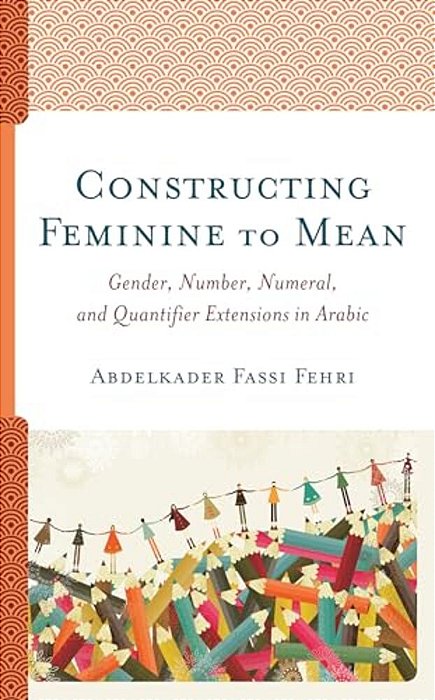
Constructing Feminine To Mean: Gender, Number, Numeral, And Quantifier Extensions In Arabic-..
até
4x
de
R$ 199,20
sem juros
ou R$ 756,96
via Pix
Adicionar ao carrinho
Disponibilidade: 45 dias úteis
Estoque: 228 unidades
-
- 1x de R$ 796,80 sem juros
- 2x de R$ 398,40 sem juros
- 3x de R$ 265,60 sem juros
- 4x de R$ 199,20 sem juros
-
R$ 756,96

-
R$ 796,80


Linguistic gender is a complex and amazing category that has puzzled and still puzzles theoretical linguists, typologists, philosophers, cognitive scientists, didacticians, as well as scholars of anthropology, culture, and even mystical (divine) sufism. In Standard and colloquial Arabic varieties, feminine morphology (unlike "common sense") is not dedicated to mark beings of the female sex (or "natural gender"). When you name the female of a "lion" (?asad) or a "donkey" (?imaar), you use different words (labu?at or ?ataan), as if the male and female of the same species are linguistically conceived as completely unrelated entities. When you "feminize" words like "bee" (na?l) or "pigeon" (?amaam), the outcome is not a noun for the animal with a different sex, but a singular of the collective "bees," "one bee" (na?l-at), or an individual pigeon (?amaam-at). In the opposite direction, when a singular noun "carpenter" (najjar) is feminized, the (unexpected) result is a special plural, or rather a group, "carpenters as a professional group" (najjar-at). Since some of these words (contrastively) possess "normal" masculine plurals, or masculine singulars, I propose to distinguish atomicities (which are broadly "masculine") from unities (which are "feminine"). The diversity of feminine senses is also manifested when you feminize an inherently masculine noun like "father" (?ab), "uncle" (?amm), etc. The outcome (in the appropriate performative context) is that you are endearing your father or uncle, rather than "womanizing" him. More "unorthodox" senses are evaluative, pejorative, diminutive, augmentative, etc. It is striking that gender not only plays a central role in shaping individuation, or perspectizing plurality, but it is also used to distinguish what we count, or what we quantifier over. In Arabic, when you count numbers in sequence (three, four, five, six, etc.), you use the feminine, but when you count objects, you have to "negotiate" for gender, due to the "gender polarity" constraint. Your quantifier senses, which are also subtly built in the grammar, equally negotiate for gender. Wide cross-linguistic comparison extends the inventories of features, mechanisms, and typological notions used, to languages like Hebrew, Berber, Celtic, Germanic, Romance, Amazonian, etc. On the whole, gender is far from being parasitic in the grammar of Arabic or any language (including "classifier" languages). It is central as it has never been.
| ISBN | 9781498574556 |
| Autor(a) | Fassi Fehri, Abdelkader |
| Editora | Lexington Books |
| Ano de edição | 2018 |
| Páginas | 248 |
| Acabamento | Capa Dura |
| Dimensões | 23,10 X 15,50 |
Produtos relacionados
-
 Constructing Number: Merging Perspectives From Psychology And Mathematics Education-..
R$ 1.659,92R$ 1.327,94até 4x de R$ 331,98 sem jurosou R$ 1.261,54 via Pix20% Desconto -
 Policy Discourses, Gender, And Education: Constructing Women's Status-..
R$ 1.942,12R$ 1.553,70até 4x de R$ 388,42 sem jurosou R$ 1.476,02 via Pix20% Desconto -
 Policy Discourses, Gender, And Education: Constructing Women's Status-..
R$ 672,22R$ 537,78até 4x de R$ 134,44 sem jurosou R$ 510,89 via Pix20% Desconto -
 Constructing Digital Cultures: Tweets, Trends, Race, And Gender-..
R$ 456,09R$ 364,87até 4x de R$ 91,21 sem jurosou R$ 346,63 via Pix20% Desconto
-

Categorias
Pague com

Selos

MYRE EDITORA, COMERCIALIZADORA, IMPORTADORA E DISTRIBUIDORA LTDA - CNPJ: 50.295.718/0001-20 © Todos os direitos reservados. 2026
