


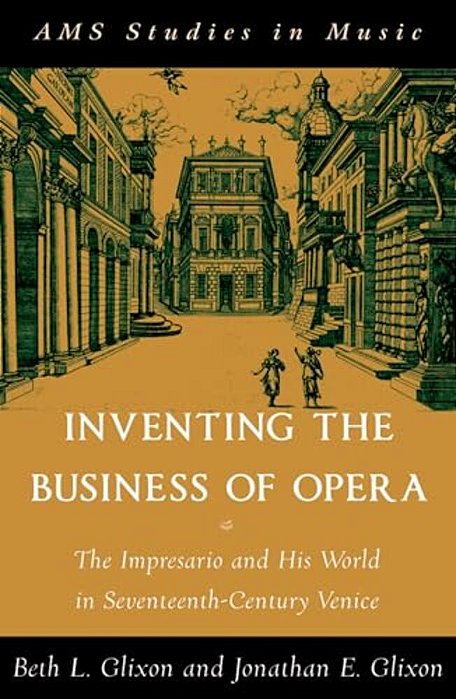
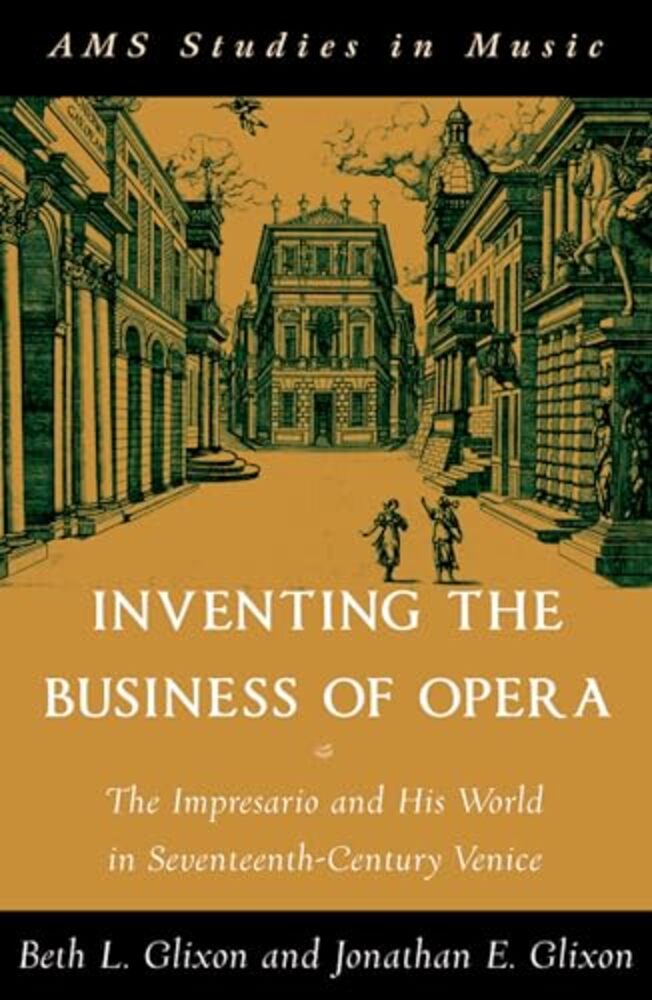
Inventing The Business Of Opera: The Impresario And His World In Seventeenth Century Venice-..
R$ 655,70
até
4x
de
R$ 163,92
sem juros
ou R$ 622,92
via Pix
Adicionar ao carrinho
Disponibilidade: 45 dias úteis
Estoque: 235 unidades
-
- 1x de R$ 655,70 sem juros
- 2x de R$ 327,85 sem juros
- 3x de R$ 218,56 sem juros
- 4x de R$ 163,92 sem juros
-
R$ 622,92

-
R$ 655,70


In mid seventeenth-century Venice, opera first emerged from courts and private drawing rooms to become a form of public entertainment. Early commercial operas were elaborate spectacles, featuring ornate costumes and set design along with dancing and music. As ambitious works of theater, these productions required not only significant financial backing, but also strong managers to oversee several months of rehearsals and performances. These impresarios were responsible for every facet of production from contracting the cast to balancing the books at season's end. The systems they created still survive, in part, today. Inventing the Business of Opera explores public opera in its infancy, from 1637 to 1677, when theater owners and impresarios established Venice as the operatic capital of Europe. Drawing on extensive new documentation, the book studies all of the components necessary to opera production, from the financial backing of various populations of Venice, to the commissioning and creation of the libretto and the score; the recruitment and employment of singers, dancers, and instrumentalists; the production of the scenery and the costumes, and, the nature of the audience; and, finally, the issue of patronage. Throughout the book, the problems faced by impresarios come into new focus. The authors chronicle the progress of Marco Faustini, the impresario most well known today, who made his way from one of Venice's smallest theaters to one of the largest. His companies provide the most personal view of an impresario and his partners, who ranged from Venetian nobles to artisans. Throughout the book, Venice emerges as a city that prized novelty over economy, with new repertory, scenery, costumes, and expensive singers the rule rather than the exception. The authors examine the challenges faced by four separate Venetian theaters during the seventeenth century: San Cassiano, the first opera theater, the Novissimo, the small Sant'Aponal, and San Luca, established in 1660. Only two of them would survive past the 1650s. Through close examination of an extraordinary cache of documents--including personal papers, account books, and correspondence -- Beth and Jonathan Glixon provide a comprehensive view of opera production in mid-seventeenth century Venice. For the first time in a study of opera, an emphasis is placed on the physical production -- the scenery, costumes, and stage machinery -- that tied these opera productions to the social and economic life of the city. This original and meticulously researched study will be of strong interest to all students of opera and its history.
| ISBN | 9780195342970 |
| Autor(a) | Glixon, Beth |
| Editora | Oxford University Press - USA |
| Ano de edição | 2007 |
| Páginas | 416 |
| Acabamento | Brochura |
Produtos relacionados
-
 Inventing The Business Of Opera: The Impresario And His World In Seventeenth-Century Venice-..R$ 1.577,00até 4x de R$ 394,25 sem jurosou R$ 1.498,15 via Pix
 -
 Inventing Lincoln: Approaches To His Rhetoric-..
R$ 165,59R$ 132,47até 2x de R$ 66,23 sem jurosou R$ 125,85 via Pix20% Desconto -
 The Seventeenth-Century Literature Handbook-..
R$ 1.660,00R$ 1.328,00até 4x de R$ 332,00 sem jurosou R$ 1.261,60 via Pix20% Desconto -
 The Seventeenth-Century Literature Handbook-..
R$ 356,49R$ 285,19até 4x de R$ 71,29 sem jurosou R$ 270,93 via Pix20% Desconto
-

Categorias
Pague com

Selos

MYRE EDITORA, COMERCIALIZADORA, IMPORTADORA E DISTRIBUIDORA LTDA - CNPJ: 50.295.718/0001-20 © Todos os direitos reservados. 2026
