


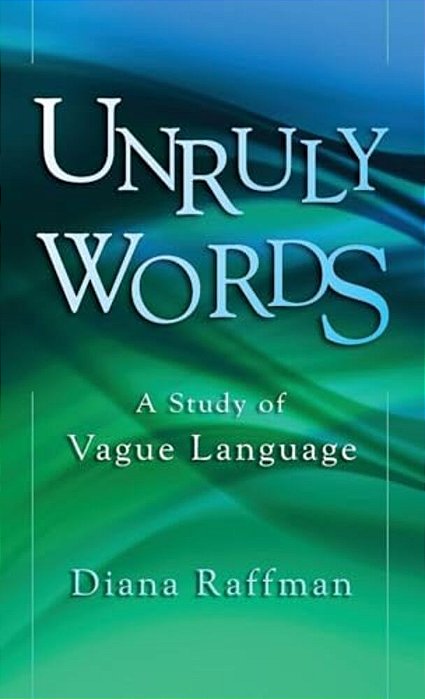
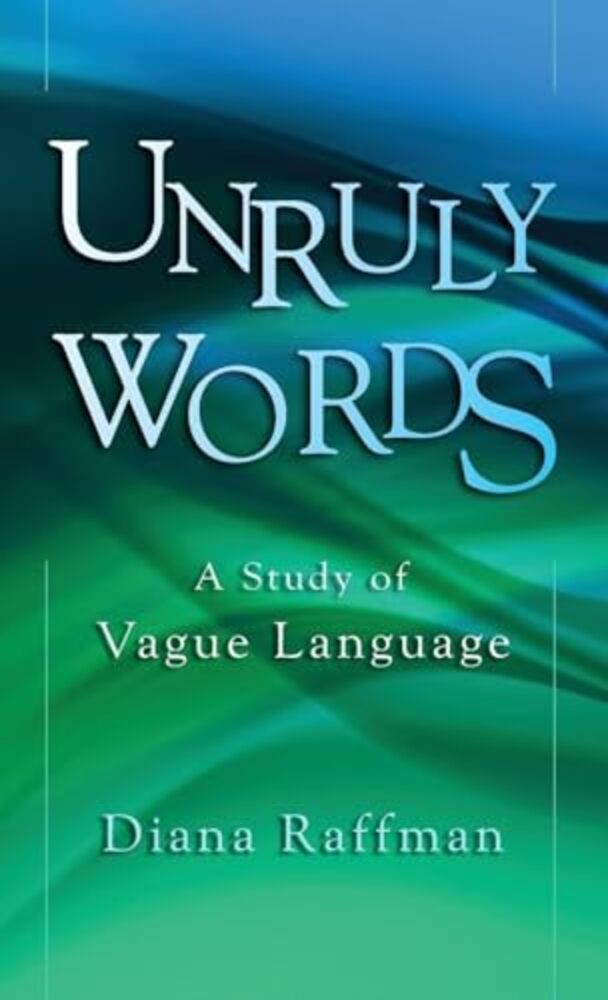
Unruly Words: A Study Of Vague Language-..
até
4x
de
R$ 154,38
sem juros
ou R$ 586,64
via Pix
Adicionar ao carrinho
Disponibilidade: 45 dias úteis
Estoque: 186 unidades
-
- 1x de R$ 617,52 sem juros
- 2x de R$ 308,76 sem juros
- 3x de R$ 205,84 sem juros
- 4x de R$ 154,38 sem juros
-
R$ 586,64

-
R$ 617,52


Vague words, like "tall," "rich," and "old," lack clear boundaries of application: no clear line divides the tall people from the above average, or the old people from the middle-aged. Because they lack clear boundaries, these ordinary words cause logical and semantic problems in various disciplines including philosophy, decision theory, and the law. Philosophers and linguists have proposed several theories of vagueness to handle these difficulties, but none has been widely accepted.Raffman contends that virtually all previous treatments of vagueness have made two crucial mistakes: they have supposed that a semantic (non-epistemic) theory must abandon bivalence, and they have paid insufficient attention to the character of ordinary speech using vague words. She develops a new theory of vagueness-the multiple range theory-that corrects both of these errors. The new theory begins with the observation that ordinary speakers seem to apply vague words in multiple arbitrarily different but equally competent ways, even when all contextual factors are held fixed. Raffman interprets this feature of their use as evidence of multiple ranges of application in the semantics of vague words, where a range of application is a range of properties whose instances satisfy the word in question; for example, a range of application of "tall" is a range of heights, a range of "old" a range of ages, and so forth. The fundamental idea is that a vague word has multiple ranges of application, and applies to things relative to those ranges, even given a single fixed context. The fact that the ranges of a vague word are arbitrarily different-there is no reason to favor any particular one-is key to solving the notorious sorites paradox.The multiple range theory preserves bivalence and is more intuitive than other approaches. It is also simpler; for instance, it has no need of a definiteness operator, and it rules out the possibility of higher-order borderline cases, both of which introduce severe complications into other accounts. Some of the evidence Raffman draws upon in constructing her theory comes from a new psychological study of the way ordinary speakers actually use vague words.
| ISBN | 9780199915101 |
| Autor(a) | Raffman, Diana |
| Editora | Oxford University Press - USA |
| Ano de edição | 2014 |
| Páginas | 240 |
| Acabamento | Capa Dura |
| Dimensões | 22,00 X 14,70 |
Produtos relacionados
-
 La Vague D'Océan-..
R$ 174,30R$ 139,44até 2x de R$ 69,72 sem jurosou R$ 132,47 via Pix20% Desconto -
 Vague Language Explored-..
R$ 912,92R$ 730,34até 4x de R$ 182,58 sem jurosou R$ 693,82 via Pix20% Desconto -
 Vague Language Explored-..
R$ 912,92R$ 730,34até 4x de R$ 182,58 sem jurosou R$ 693,82 via Pix20% Desconto -
 The Library Of Unruly Treasures-..
R$ 149,32R$ 119,46até 2x de R$ 59,73 sem jurosou R$ 113,49 via Pix20% Desconto
-

Categorias
Pague com

Selos

MYRE EDITORA, COMERCIALIZADORA, IMPORTADORA E DISTRIBUIDORA LTDA - CNPJ: 50.295.718/0001-20 © Todos os direitos reservados. 2026
